Spirals of Kemush: An Illustrated Myth App for iPad and iOS
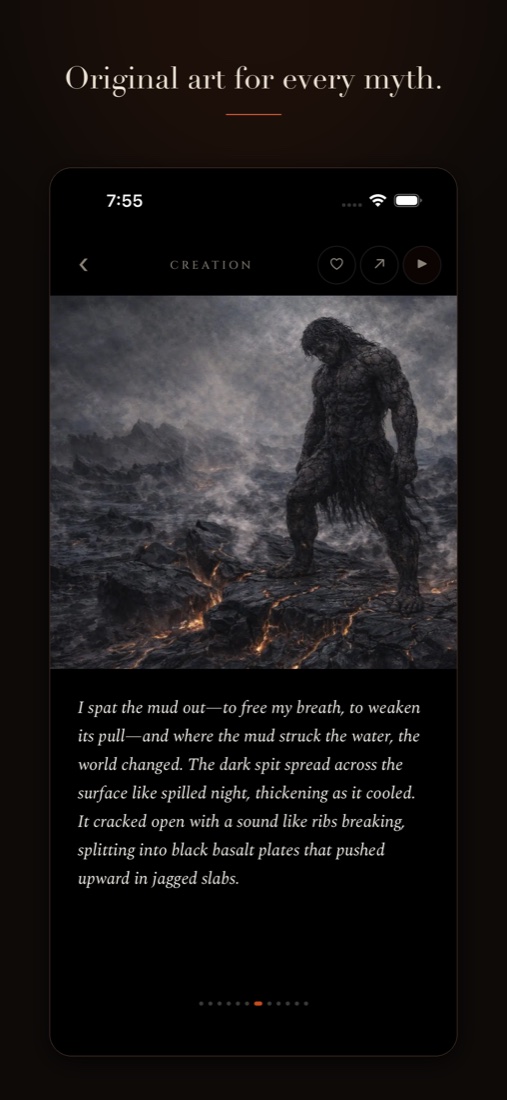
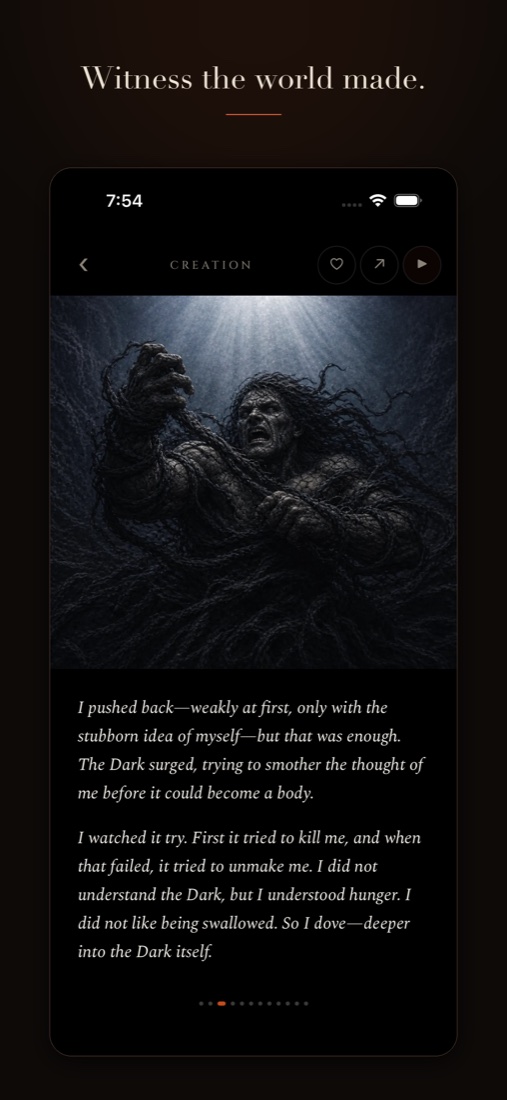
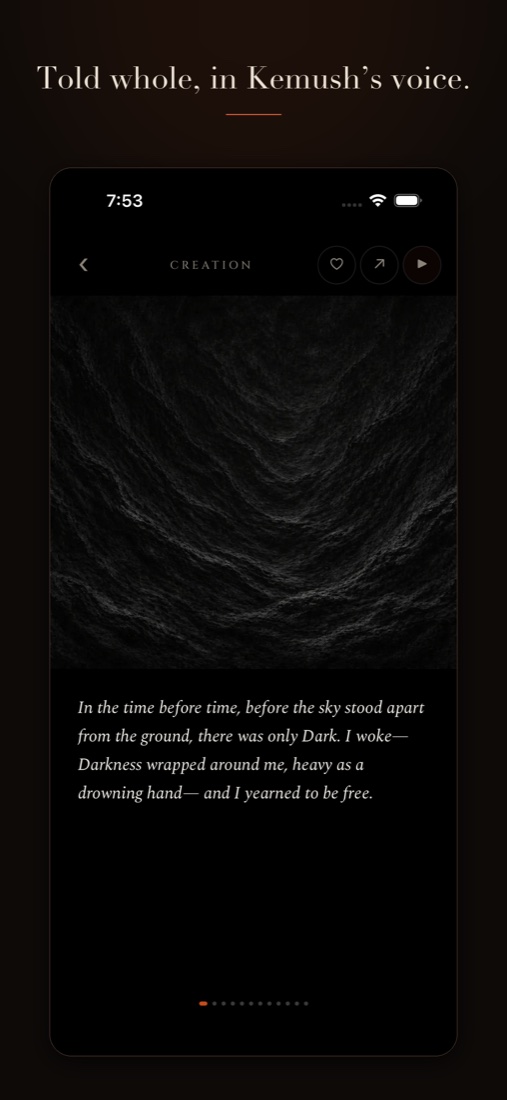
Spirals of Kemush is a fully illustrated myth-reading app for iPad and iPhone, built around the complete text of The Book of Spirals, a literary cycle of twelve Modoc origin myths. The stories run from the obsidian dark before time through the threshold of human memory, sequenced so that each myth deepens what came before it. The app pairs the text with 190 painterly panels created to move a reader through the cycle on a tablet screen, with an optional read-aloud voice for listeners who want to hear the language as well as read it.
The app runs fully offline. Once installed, it requires no network connection, and the full text and all 190 panels are available regardless of where a reader opens it.
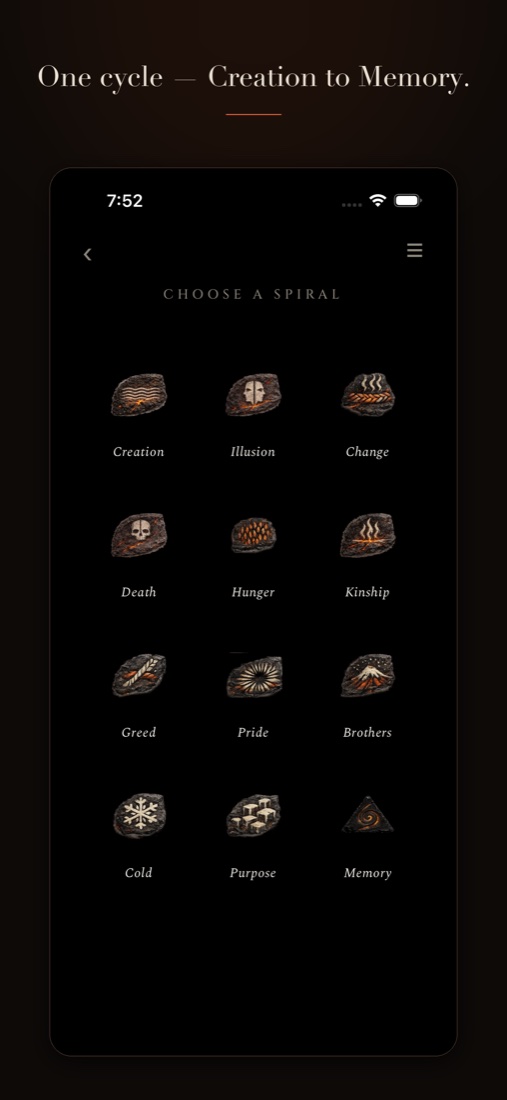
The Twelve Spirals: Creation Through Memory
The Book of Spirals sequences twelve myths under twelve themes: Creation, Illusion, Change, Death, Hunger, Kinship, Greed, Pride, Brothers, Cold, Purpose, and Memory. The names are descriptive. Creation opens on the emergence of form from darkness, and Memory closes on what survives the end of a world. Each myth is its own complete story, and together they trace an arc that gives the reader something to follow from beginning to end.
The sequencing was built for both linear reading and selective use. A reader following the cycle straight through experiences the myths as a unified work. A teacher who wants to anchor a discussion around the theme of Kinship or Cold can open that myth without requiring students to have worked through the preceding ones. The structure holds the cycle together while leaving it accessible from any point.
Kemush: Witness and Mediator at the Center of the Cycle
Kemush stands at the center of the cycle as witness and mediator. He watches, he participates, he holds the frame. His presence across the twelve spirals gives the reader a point of continuity in a cycle that moves through creation, death, seasons, and memory. He is the figure you can return to, and the figure through whose witness the reader understands what each myth is doing.
The role Kemush plays in The Book of Spirals is a literary one, shaped by the tradition that formed him and built in gratitude and respect toward it. The line between a new literary mythos and sacred or ceremonial tradition is one this work keeps clearly drawn. Nothing restricted is reproduced here. What is carried forward is the landscape, the themes, and the quality of the stories as stories.
Why These Stories Matter: The Klamath Basin, the Modoc World, and What Is at Stake
The Modoc homeland runs through the high desert and lava country of the Klamath Basin, a landscape of obsidian flows, marsh systems, juniper plateaus, and the great lake chains that shaped everything the Klamath and Modoc peoples built over generations. These stories come from that place. They carry the specific textures of that ecology in ways that general treatments of mythology almost never do: the quality of cold at elevation, the pressures of hunger in a seasonal landscape, the relationships between people and water that define life in the basin.
The Modoc people experienced a dispossession so complete and so recent that much of what could be lost has been lost. The Modoc War of 1873 ended in executions and forced exile, and the community has been in recovery ever since. Stories are part of what is recovered and rebuilt. A literary mythos built in gratitude toward that tradition, reaching readers who would otherwise never encounter these themes or this place, is part of that work.
What Spirals of Kemush Teaches: The Educational Model
The twelve-spiral sequence was built with classroom use in mind. Each myth addresses a theme that translates into discussion, analysis, and comparison across traditions: how does this world understand the emergence of hunger as a force in human life? What does it mean that pride reshapes the world in the myth dedicated to it? What kind of ecology produces a story of Cold built around survival in a hard season? The themes are legible to a student who has never encountered Modoc material before, and they open outward into broader conversations about ecological knowledge, ethics, kinship, and narrative structure.
A literature course might read the cycle from Creation to Memory as a unified work, tracing how each spiral shifts the reader's understanding of the ones before it. A Native American studies or social studies course might use individual myths as entry points into specific themes or historical contexts. The read-aloud feature makes the text accessible to younger readers and English-language learners while keeping the language of the myths intact.
The 190 panels do interpretive work throughout. They slow the reader at moments that reward attention, give visual weight to transitions between myths, and hold the atmosphere of the Klamath Basin without describing it discursively. A student arriving at the panel that opens Cold is already inside the landscape of that myth before reading a word.
What the Work Is For: Community, Cultural Transmission, and the Next Generation
The goal is to put these stories in front of readers and students who would otherwise never find them, carried as living literature that belongs to a specific place and a specific people, with something to say to any reader willing to read carefully. The app form matters here. An iPad in a classroom in Klamath Falls or Chiloquin, or anywhere else with Indigenous students and teachers who want to work with this material, is a form that asks little of the institution and puts the full illustrated cycle in a student's hands.
Henry Delaney is an enrolled member of the Klamath Tribes with Modoc ancestry. This work comes from that place. Its aim is clear: to build a literary cycle worthy of adjacency to that tradition, one that honors what shaped it, stays honest about what it is, and can carry the names and landscape and themes of the Modoc world to the next generation of readers, to students in the Klamath Basin and beyond, and to Indigenous communities looking for their stories in forms that travel.