The Maklak War: A Generational Simulation of the Klamath Basin
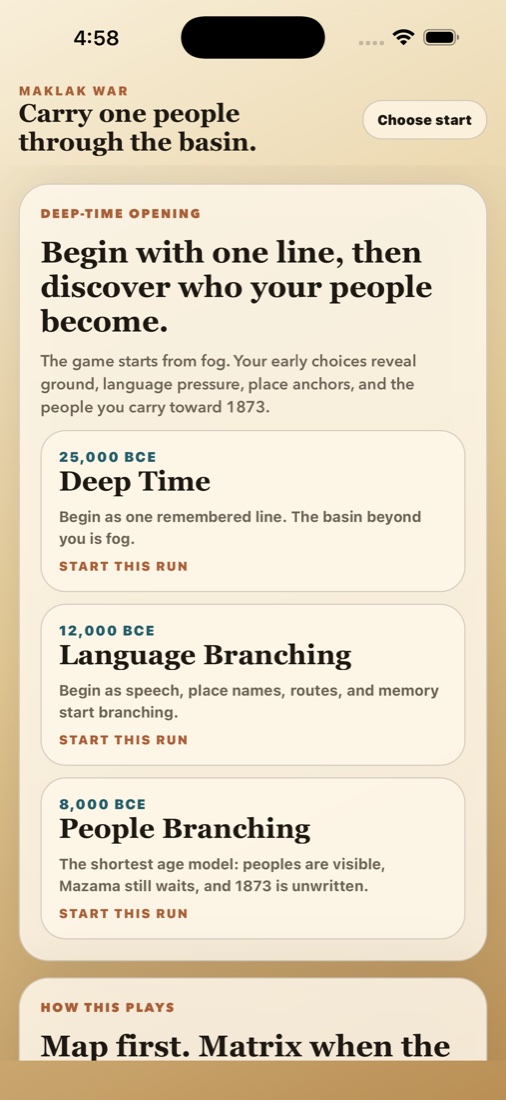
The Maklak War is an in-development iOS simulation that asks you to carry one people through the Klamath Basin from 25,000 BCE to 1873. The engine is deterministic. The same starting conditions produce the same outcome every time, so real Klamath and Modoc history and real Basin ecology live inside the system as working causes. What happens on screen is generated by the conditions that came before it, and the shape of a run grows out of everything the people have already carried.
That is roughly twenty-seven thousand years of one specific place and one specific people. The title names both a people and a conflict. The architecture reaches all the way back to the earliest human presence in the Basin because 1873 grows out of that whole span, and the game treats the whole span as its subject rather than as a preamble to the war.
Three Screens: The Run State, the Map, and the Cultural Decision Matrix
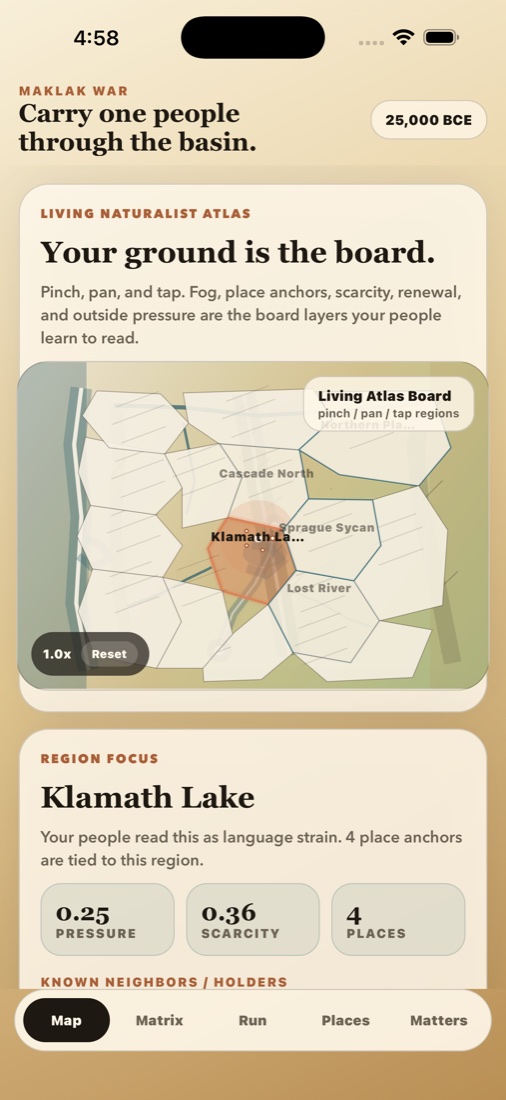
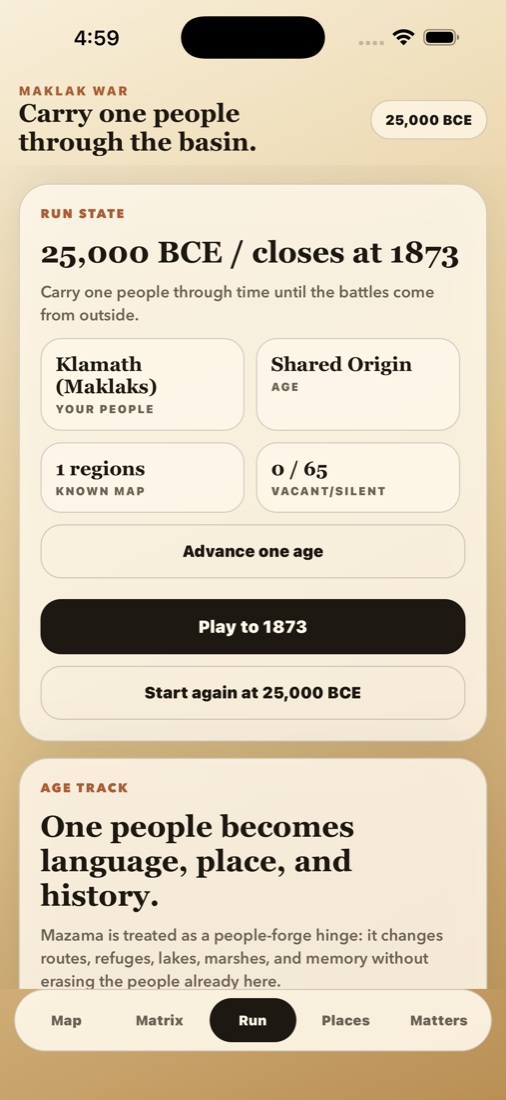
The simulation runs on three primary screens. The Run state carries your people forward in time, gathering conditions that compound across generations. The Map renders the physical landscape they inhabit, a world that shifts over millennia as lakes rise and fall, marshes spread and contract, and routes that once carried people become impassable. The Cultural Decision Matrix is where the heaviest choices sit.
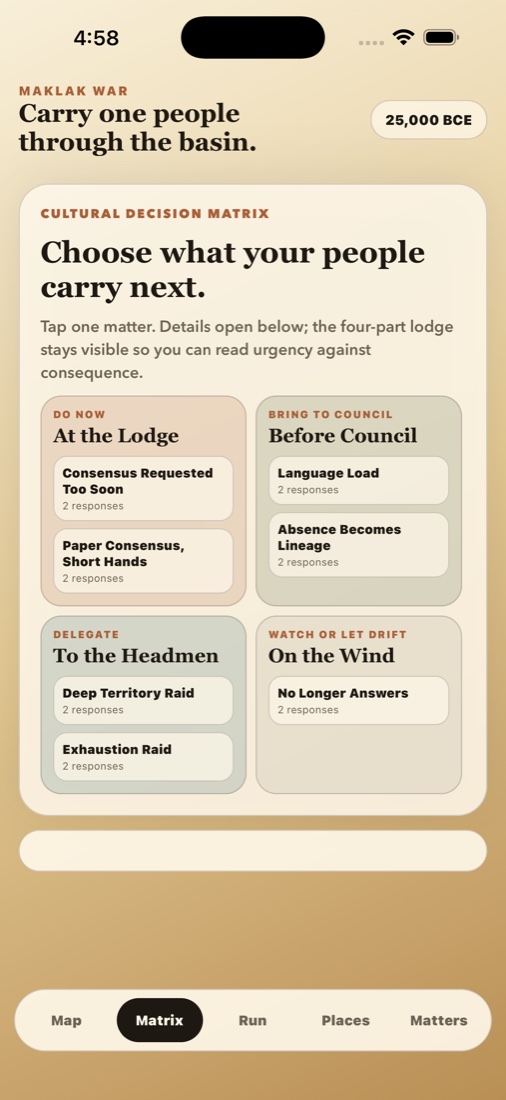
The Cultural Decision Matrix holds the decisions about what your people carry forward: knowledge, practice, language, and their relationship to place. Each decision gives you four ways to move. You can act now at the lodge, which is fast and direct. You can bring it before council, which is slower and builds shared weight behind the choice. You can delegate it to the headmen, which spreads the work and lets it vary from hand to hand. Or you can watch and let it drift into the community without direction, which is the most fragile way for anything to pass down. Each path changes what survives and what thins out over the generations that follow.
The deterministic architecture is itself an argument about history. Because the same inputs produce the same outputs, the simulation rewards a player who reads actual conditions and works with them. What the Klamath and Modoc built over thousands of years in the Basin was specific and durable, and the engine is designed to make that specificity legible while you play.
Mount Mazama, Crater Lake, and the Reorganization of the World
At some point deep in the run, Mount Mazama erupts. This is the eruption that emptied the mountain and left the caldera that became Crater Lake, one of the largest volcanic events in the recent geological record of the region. In the simulation, Mazama is a people-forge hinge. The eruption changes which routes stay viable, reshapes the refuges people fall back on, and alters the Basin's water. Lakes and marshes shift. The geography the player has spent generations reading gets remade underneath them.
What your people carry through that rupture, and how they carry it, becomes one of the heaviest variables in the rest of the run. Knowledge of the Basin's water, built up through council decisions and lodge practice, meets a reorganized landscape one way. Knowledge that was left to drift meets it another. Mazama remakes the world, and the question it puts to the player is how a people's accumulated understanding holds when the ground under it changes.
The Klamath Basin, Its History, and What Is at Stake
The Klamath Basin is one of the richest wetland landscapes in the American West, a volcanic plateau between the Cascades and the High Desert, with cold rivers, marsh-fed lakes, and a major waterfowl corridor along the Pacific Flyway. The Klamath, Modoc, and their neighbors have lived there for as long as the oral tradition and the archaeological record can reach. Their knowledge of the Basin is the product of continuous life in one specific place, across a span of time most historical frameworks struggle to hold.
The year 1873 is the year of the Modoc War and the siege at Captain Jack's Stronghold, in the lava beds south of the lake. That outcome is usually told as a single event, a last stand and a defeat. The simulation is built on the longer reading. 1873 is the consequence of everything that came before it, and the only frame that makes the conflict fully legible is the long one: how a people's relationship to their land and their institutional memory shaped what they were able to do when dispossession arrived. Ecological continuity and cultural continuity are woven together in the Basin's history, and the simulation keeps them woven.
The Educational Model: Deep Time, the Structure of History, and Carrying Memory
The educational model of the Maklak War rests on three linked things: deep time felt across generations, the structure of history underneath the dates, and the concrete question of how a people carries language, place, and memory through rupture.
Deep time is the hardest of these to make real. You can tell a student that the game opens more than twenty-five thousand years before the Modoc War, and the number stays abstract. The simulation makes it land by putting the player inside the accumulation. A choice made in the Cultural Decision Matrix early in the run shows its consequences on the Map generations later. Language held together through council keeps a specificity that delegated, drifting language loses. Place names hold ecological memory, and when Mazama erupts, the people who carry deep knowledge of the Basin's water navigate the aftermath with an advantage the others do not have. The mechanics carry these arguments in play, where a student can feel them work.
The structure of history is the second tier. A student who carries a people through the whole run starts to see cause as a long chain, where each link tightens the next. 1873 arrives as the end of a series of pressures and responses that built across the generations the player has been managing, and that player understands, in a felt way, why the outcome landed where it did. Reading history as structure gives a student something a timeline on its own cannot.
The third tier is the carrying itself. Language, place, and memory do not move down the generations on their own. Someone has to choose to carry them, at a cost, against everything pulling the other way. The Cultural Decision Matrix makes that carrying the core action of the game, so a player learns what it takes to keep a word, a place name, or a practice alive across a rupture, and learns it by doing the work of carrying it.
Made for the Klamath and Modoc Community and the Next Generation
The Maklak War is a first look, still in development and not yet on the App Store. From the start, the work has been shaped by one orientation: it is for the Klamath and Modoc community first, and for the next generation growing up in and around the Basin. The aim is to build something the community's own children can sit with, so they can feel the weight of what their people carried across roughly twenty-seven thousand years and what it took to carry it.
Carrying a tradition through a rupture as deep as the nineteenth century asks for structures that let young people live inside it. A simulation that puts a player inside generational decision-making, that makes the cost of losing language or place knowledge tangible across the run, that turns Mazama into an event you feel your way through, is one way to build such a structure. H.L. Delaney, who is making the game, is an enrolled member of the Klamath Tribes with Modoc ancestry. The work sits close to the tradition that shaped him, made in gratitude and in respect. It stays in the domain of history, ecology, and the structure of how a people endures, and it does not reproduce anything sacred or restricted. The game is for the community first, and for that community's next generation.