What Auntie's Baskets Is
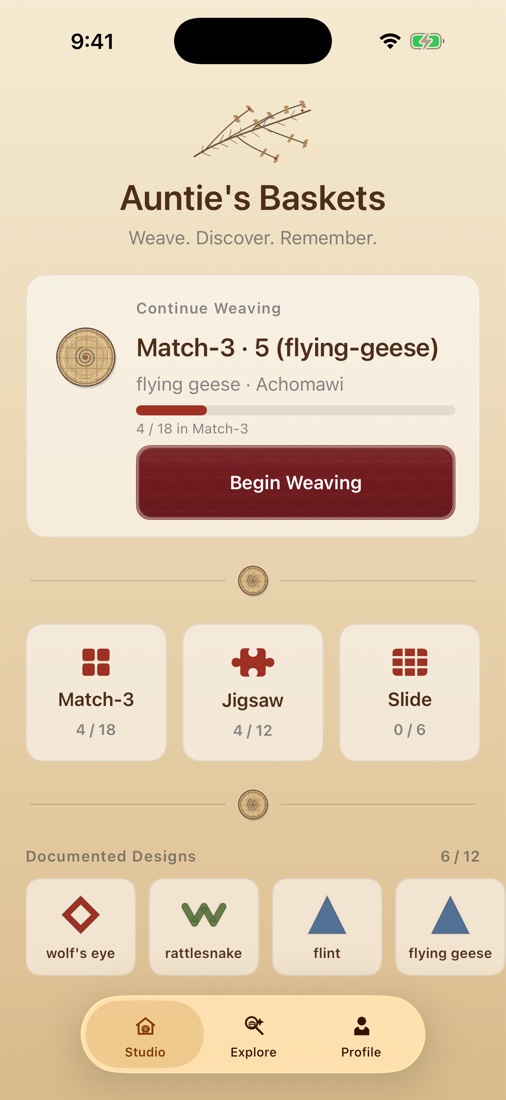
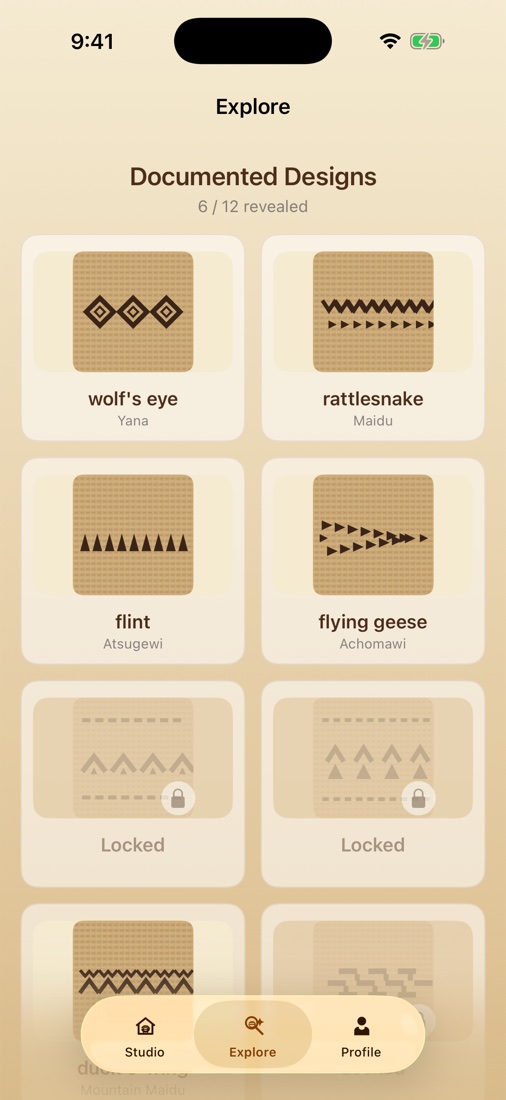
Auntie's Baskets is a live iOS puzzle game built on 42 real, documented basket designs from the Indigenous peoples of Northern California: the Maidu, Yana, Yurok, Karok, Hupa, and others whose weaving traditions have been carried in these watersheds for generations. The game gives players three ways to work with these patterns, through Match-3, Jigsaw, and Slide puzzles, and when a board is finished the pieces resolve into the actual motif that underlies it. Solving the puzzle opens the design's recorded name, the people who wove it, and its documented story and credit.
There are no timers, no lives, and no leaderboards. The game moves at your own pace, and the point of playing is the pattern you uncover.
How the Game Plays
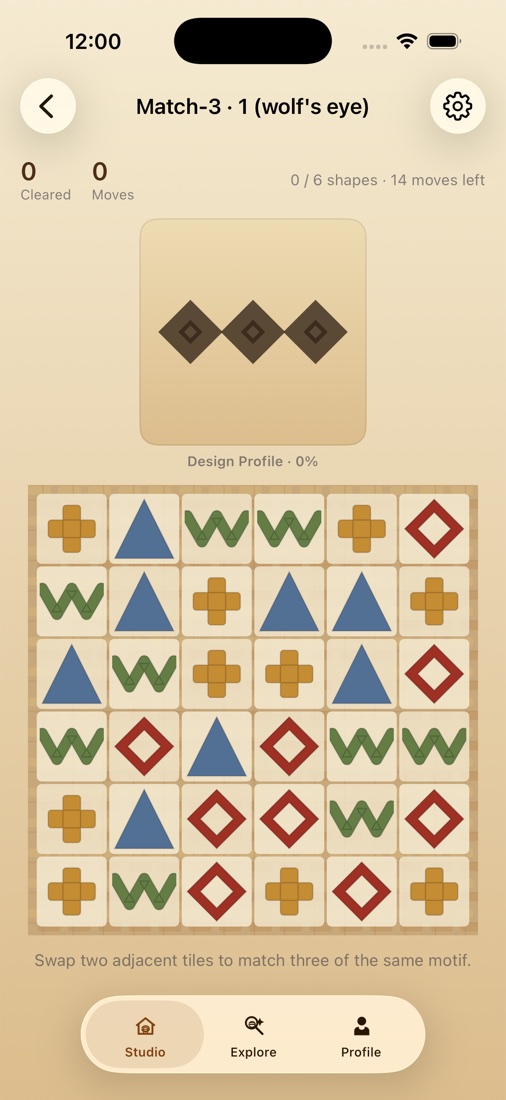
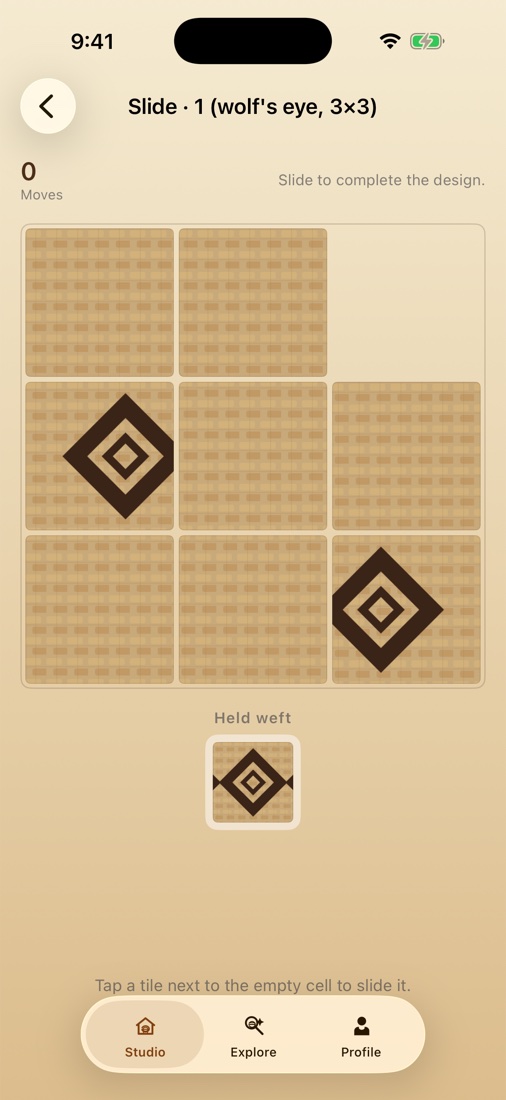
In Match-3 mode, a grid of colored tiles carries the geometry of a basket motif spread across its cells. Clearing the board by matching adjacent pieces gradually brings the design up underneath. In Jigsaw and Slide, the motif is given more directly but scrambled or taken apart, and the work is putting it back together. Each mode gives a slightly different relationship to the pattern: in Match-3 you work through it piece by piece without seeing the whole, and in Jigsaw and Slide the whole sits in front of you but broken.
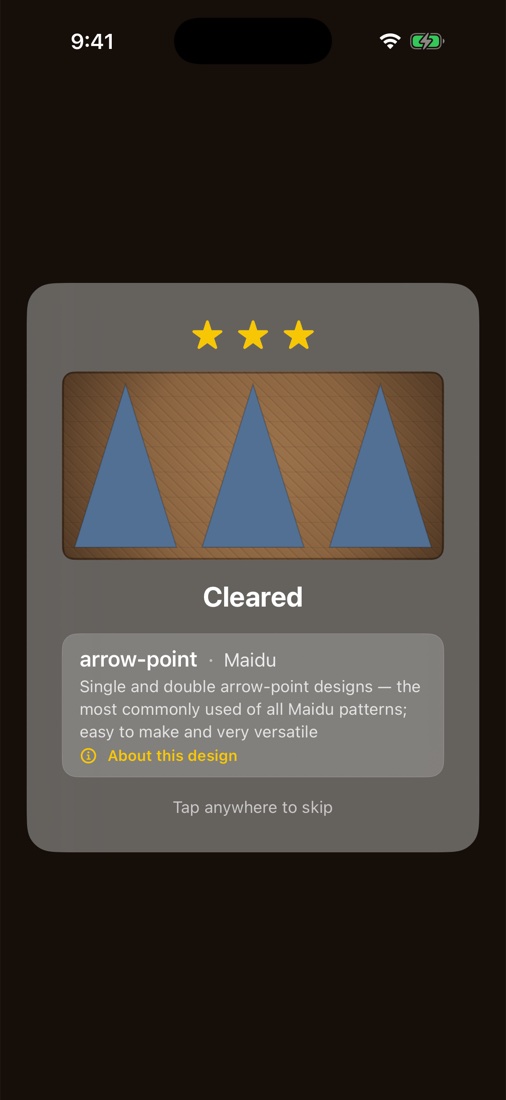
What stays constant across all three modes is the reveal. Finishing a board opens a screen with the basket's name as it appears in the documentary record, the people it belongs to, and whatever story and attribution the documentation carries. The game passes that record through in the source's own terms and leaves the credit with the maker.
The Peoples and Their Designs
The 42 designs in Auntie's Baskets come from documented collections that span several of Northern California's distinct weaving traditions. Yurok and Karok homelands lie along the Klamath River corridor, and the Hupa are their neighbors on the Trinity. Maidu homelands run through the Sierra Nevada foothills and the northern Sacramento Valley. The Yana homeland lies in the eastern Sacramento Valley and its foothills, where the violence of the nineteenth century devastated the people and came close to ending them as a distinct nation. These are separate nations with their own languages, histories, and design vocabularies, and the game holds them as such.
Documented here means these designs exist in ethnographic records, museum holdings, and archival materials. They were written down by name, attributed to specific peoples or weavers, and kept in institutional collections. That preservation is complicated and contested, and the game does not pretend it is simple. What the game does is draw from that record and pass the documentation through to the player, correctly credited and unchanged.
Why the Designs Matter
A basket is a tool and a record at the same time. Across California Indian traditions, woven baskets were used for gathering, for processing and cooking food, for carrying and storing it, and for cradling children; they were given as gifts and stood as measures of skill, wealth, and relationship. The geometric patterns worked into them were deliberate. They carried names. They held memory. They marked the weaver and the people the weaver belonged to. When those patterns circulate without attribution, cut loose from the people who made and carried them, something is lost that matters.
The peoples of Northern California went through sustained and violent dispossession across the nineteenth and twentieth centuries, and the loss of material culture, including the living transmission of weaving knowledge, is part of what that history cost. Documentation preserved designs that might otherwise be invisible today. Keeping that documentation in circulation, and making sure the credit travels with each design, is one way of honoring what the record holds.
What Auntie's Baskets Teaches: The Educational Model
The teaching structure in Auntie's Baskets is direct: every solved board opens its attribution. A player who finishes a Yurok pattern learns its name in the documentary record, that it belongs to the Yurok people, and whatever the sources preserve about it. A player who works through a Maidu design gets the same: name, people, story. The game delivers this after the puzzle, which means the player has already spent time inside the pattern before learning what it is. That sequence matters.
In most puzzle games the finished image is simply the reward for completing the puzzle. In Auntie's Baskets the finished image is a specific historical and cultural object with a name and a maker, and the game is built to make that plain. The aim, at the level of habit, is to teach that a woven pattern holds memory and identity and belongs to someone, and to make that concrete by grounding it in real, named designs from real, named peoples.
A player who works through the full game will have moved through 42 distinct designs from the Maidu, Yana, Yurok, Karok, Hupa, and others. They will have learned those peoples' names, and something of the range and specificity of what Northern California's weaving traditions produced. For most players that is a first real introduction to traditions they will never have met in a school curriculum, and it arrives through a form they already know how to use.
What the Work Is Intended to Do
The immediate intent is to keep these documented designs in circulation and to make sure the credit travels with them. Museum and archival collections hold this material, but they are not where most people run into it. A puzzle game on someone's phone is a place where they will. If the game does its job, a player who finishes it knows these peoples and their material culture more accurately than before, and knows it through time spent working with the patterns directly.
The longer horizon is the next generation. The Indigenous communities these designs come from are living communities. Their members are on phones and tablets, inside the same media environment as everyone else. A game that treats their ancestors' work with respect and specificity, and credits it correctly, carries itself differently in that environment. The living transmission of weaving knowledge belongs to families, communities, and cultural programs. What a game can add is putting a young Yurok, Karok, or Maidu person in contact with their peoples' design vocabulary, correctly attributed, in a medium they already use.
Auntie's Baskets was built by H.L. Delaney, an enrolled member of the Klamath Tribes with Modoc ancestry, and published through Basalt Sea Press, a Native-owned press. The intent behind it is the same intent behind the rest of that work: to build things that serve the communities they come from and that honor the traditions they sit alongside, as carefully and honestly as the work allows.